

POLITICS NEWS - Africa’s young people remain committed to democracy, but frustration over economic pressure and unresponsive leadership means a majority today reject the idea that Western-style democracy offers the right model for the continent, according to the 2026 African Youth Survey.
The latest African Youth Survey, commissioned by the Ichikowitz Family Foundation and conducted by PSB Insights, interviewed 4,901 young Africans aged 18 to 24 across 16 countries in March 2026.
It is the largest edition yet of the recurring survey, which was launched in 2020 to give governments, business, civil society and the media a rigorous understanding of the views of Africa's rising generation.
The 2026 survey shows young Africans continue to support elections, free speech, equality before the law and accountable government. But at the same time they want political systems that are more rooted in African realities and more capable of delivering jobs, services, stability and representation.
It also exposes a direct challenge to Africa's older political class: 76% say leaders are out of touch with young people, 76% say there are too few young people in government and 65% support age limits for presidents and prime ministers.
The findings arrive after a wave of youth-led mobilisation across parts of the continent, with Gen Z protesters taking to the streets over taxation, corruption, cost of living pressures, public services and political accountability.
The survey provides a wider context for these movements and suggests that youth mobilisation should not be read simply as anti-government anger, but rather reflect a wider generational demand for systems that listen to and deliver for Africa’s young people.
Some 73% of respondents said democracy is always preferable to any other form of government, up from 71% in 2024. Support for non-democratic government has fallen to 23%, from 27% in 2024.
Nearly two-thirds (64%) reject one-party rule and clear majorities oppose abolishing elections and parliament in favour of unchecked presidential authority.
Yet one of the survey's most significant findings is that 56% say Western-style democracy is not suitable for Africa.
Although the figure has fallen slightly from 61% in 2024, it points to a generation seeking a democratic model that reflects African realities rather than imported assumptions and shows that young Africans continue to question whether imported institutional models are sufficiently responsive to local realities, economic pressures and expectations of leadership
When asked what African-style democracy should mean, respondents put national unity and stability first (48%), followed by free and fair elections (46%), leaders who create jobs and provide services (43%) and community participation (36%).
The responses show that ‘African-style democracy’ is not a fixed doctrine, but a broad demand for systems that feel legitimate and effective.
Ivor Ichikowitz, Founder and Commissioner of the African Youth Survey, said:
“Let us be honest about what Africa’s young people are saying. They have not abandoned democracy. They have abandoned the patience to be lectured about democracy by leaders and institutions that cannot deliver work, safety, fairness, clean government and a future worth staying for.
“That is why an African form of democracy is not a retreat from democratic values. It is the only way to make them real. Africa’s young people want elections, rights and freedom of speech, but they also want systems rooted in their own societies, capable of holding nations together, creating jobs – and giving communities a genuine voice. If they don’t get that then we risk losing a generation it is meant to serve.”
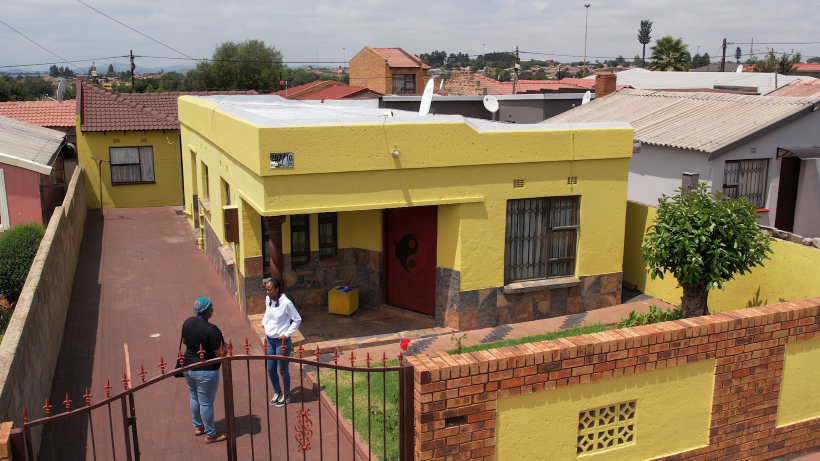 AYS2026 field work is done across Africa including at peoples' homes.
A generation that feels powerful, but not understood
The survey also highlights a sharp generational disconnect. On one hand, 70% of young Africans say their voice matters to national leaders and 84% are confident that young people can meaningfully influence political decision-making over the next five years.
But though African youth believe they can shape politics, many do not believe existing leadership structures are sufficiently responsive to them. In Nigeria (38%), South Africa (48%) and Congo Brazzaville (48%), fewer than half of respondents say their voice matters to national leadership.
More than three-quarters (76%) say there are too few young people in government, while 79% would be more likely to vote for a political party that fielded more young candidates. A further 79% support creating a dedicated Minister for Youth and 65% support age limits for presidents and prime ministers, with 57 years old identified as the preferred upper limit.
Ichikowitz added: “While young Africans believe in their own ability to create change, most also believe political leaders remain disconnected from their realities and aspirations. This creates both an opportunity and a risk. Governments that genuinely engage young people, bring them into decision-making and create pathways for leadership will unlock enormous energy and innovation. Those that continue to treat youth as spectators rather than partners risk becoming increasingly disconnected from the societies they govern.”
Not anti-democracy, but anti-failure
The survey also shows that young Africans are weighing democratic process against practical delivery more openly than before. Respondents are almost evenly divided between governments that deliver effectively even if democratic input is limited (48%) and governments that strictly uphold democratic procedures even if decision-making is slower (47%).
Ichikowitz added: “What this finding reveals is something deeper: a growing frustration with democratic systems that promise inclusion and opportunity but fail to deliver meaningful improvements in people's daily lives.
“Perhaps the most important lesson is that African youth do not see a contradiction between democracy and delivery. They want both. They want freedom and opportunity. They want accountability and effectiveness. They want elections and economic progress.”
This tension is particularly striking in countries with strong democratic traditions. Youth in South Africa (61%) and Ghana (60%) are more likely to prioritise governments that can deliver results quickly and effectively.
By contrast, youth in countries where democratic systems have faced greater pressure, such as Zambia (66%), Mozambique (60%) and Chad (58%), are more likely to prioritise democratic process.
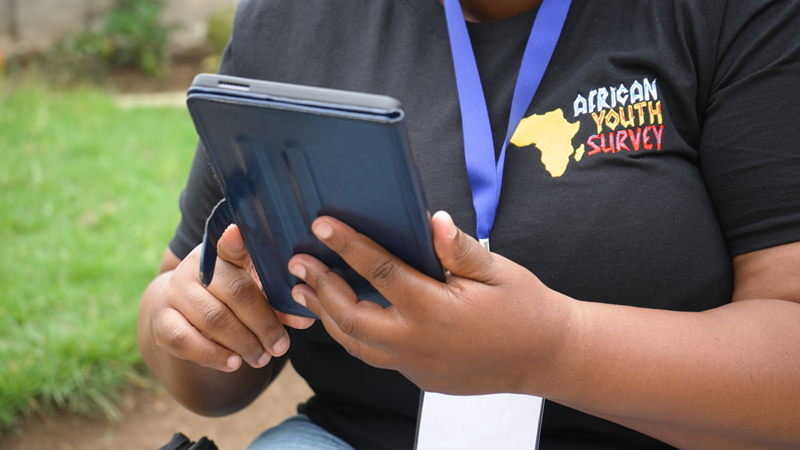
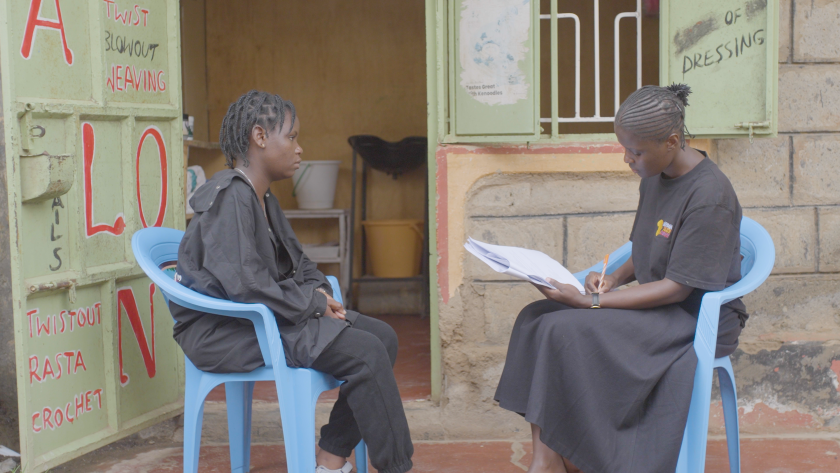 An African Youth Survey researcher prepares to conduct a survey outside a shop in Nairoibi, Kenya, for the 2026 report
A varied continental picture
The survey reveals substantial variation across the continent. Support for democracy is strongest in Zambia (83%) and Kenya (81%). Burkina Faso presents one of the most complex pictures, with 49% saying democracy is preferable and 44% saying non-democratic government can be preferable under certain circumstances.
Countries also differ sharply on whether young people feel heard by leaders, whether they feel treated equally before the law and whether they support different forms of political action.
The results underline a sharply varied continental picture, shaped by different economic, security and governance realities.
The Afro-optimism paradox
The demand for a more Africa-appropriate democratic model comes at a moment when young Africans are more optimistic than they were two years ago. Some 43% now say Africa is going in the right direction, up from 37% in 2024 and a return to pre-pandemic levels.
Over half (51%) say they are optimistic or excited about the future of their own country, a sharp rise from 35% in 2024. Yet the rising cost of living remains the single biggest pressure of the past five years, and jobs and corruption now sit at the top of the youth agenda.
This renewed optimism is not evenly distributed. Confidence is highest in Rwanda, Somalia, Burkina Faso and Ghana, while pessimism remains pronounced in Kenya, South Africa, Mozambique, Chad and Nigeria.
The results point to a continent where the overall mood is recovering, but where the experience of young people still differs sharply from country to country.
The rising cost of living is named as the single event or development that has had the biggest impact on Africa over the past five years, selected by 27% of respondents. When asked what Africa most needs to progress, young Africans put creating new, well-paying jobs first at 27%, followed closely by reducing government corruption at 25%.
Making it easier to start a business is now selected by 16%, up from 10% in 2020.
A full copy of the report can be downloaded here.
Further key African Youth Survey 2026 findings:
- 73% say democracy is always preferable, while 23% say non-democratic government can be preferable, down from 27% in 2024.
- 64% reject one-party rule, while clear majorities oppose abolishing elections and parliament in favour of unchecked presidential authority.
- 56% say Western-style democracy is not suitable for Africa, but equality before the law, free and fair elections and freedom of speech remain the most valued democratic principles.
- 48% prioritise effective delivery, while 47% prioritise fully democratic procedures.
- 76% say there are too few young people in government, 79% would be more likely to vote for parties fielding more young candidates and 79% support creating a dedicated Minister for Youth.
- 65% support age limits for presidents and prime ministers, with 57 identified as the preferred upper age limit.
- 68% believe their country would be better governed if more women held senior positions, while 65% support reserving a set number of government positions for women.
- 60% say their country should build strong alliances with one or two major global powers to secure long-term benefits, while 37% prefer neutrality.
- 80% are concerned about the influence foreign powers have on their country.
- When choosing international allies, 43% prioritise infrastructure and economic investment, followed by respect for natural resources at 39%, democratic values and human rights at 34%, sovereignty and non-interference at 34%, technology transfer at 30% and military and security support at 29%.
- 72% are concerned about asylum and immigration, while 57% are satisfied with their government’s efforts to limit illegal immigration.
- 80% worry about human trafficking, 79% about the smuggling of drugs or weapons and 78% about armed groups crossing borders.
- 80% agree that the UN Security Council needs reform to include permanent African representation.
About the African Youth Survey
The most comprehensive study of its kind to date, the African Youth Survey 2026 gives a voice to one of the world’s most consequential demographics, providing young Africans with the opportunity to share their opinions, experiences and ambitions with the world.
Since its inception in 2020, the Survey has become a valued resource for policymakers, media and stakeholders seeking high-quality research on the issues that matter most to Africa’s youth. Research is conducted by PSB Insights, a global insights consultancy, and since 2020 the survey has covered 28 countries with over 18,000 face to face interviews.
Interviews were conducted in March 2026. Approximately 300 interviews were carried out per market, with a 50:50 male to female sample split. Respondents were nationals of the country surveyed aged 18-24 and were offered the survey in local languages. No incentives were offered as part of the research.
Where 2026 African Youth numbers are shown on their own, this includes all countries surveyed for this year’s research: Burkina Faso, Chad, Congo Brazzaville, Democratic Republic of Congo, Ethiopia, Ghana, Kenya, Liberia, Mozambique, Nigeria, Rwanda, Somalia, South Africa, Togo, Zambia and Zimbabwe.
Comparisons of change between 2020, 2022, 2024 and 2026 are shown only among countries that have been researched in every wave of research, which are Congo Brazzaville, Ethiopia, Ghana, Kenya, Nigeria, Rwanda, South Africa and Zambia.
‘We bring you the latest Garden Route, Hessequa, Karoo news’