


POLITICAL NEWS - The latest national polling ahead of Election 2026 shows that the gap between the DA and the ANC has narrowed to seven percentage points.
The latest polling by the Social Research Foundation (SRF) says the DA stands at 27% nationally while the ANC's support has fallen to 34%, a huge drop since the May 2024 national election.
According to the SRF, ANC voter support experienced a steady decline ahead of the May 2024 election, dropping from around 45-52% in 2023 to 37% by April 2024, largely driven by the emergence of the MKP.
Late tracking models in May 2024 indicated a slight recovery to roughly 42% just before the 2024 election and the ANC ended up securing 40,18% of the national vote. The DA secured 21,81% of the vote.
Ashor Sarupen, DA National Campaign Manager, says the SRF’s polling ahead of the 2024 election proved highly accurate.
"Its latest numbers confirm the trend we are seeing across the country: the DA is growing, the ANC is declining and South African politics is becoming intensely competitive," Sarupen says.
The DA launched its national manifesto in Johannesburg on Saturday where the SRF poll indicates that Helen Zille's mayoral campaign is bearing fruit.
The DA is leading the race to rule Johannesburg with 42%; the ANC is a bad second with only 18% of voters' support and in third place is the MK Party with 13%.
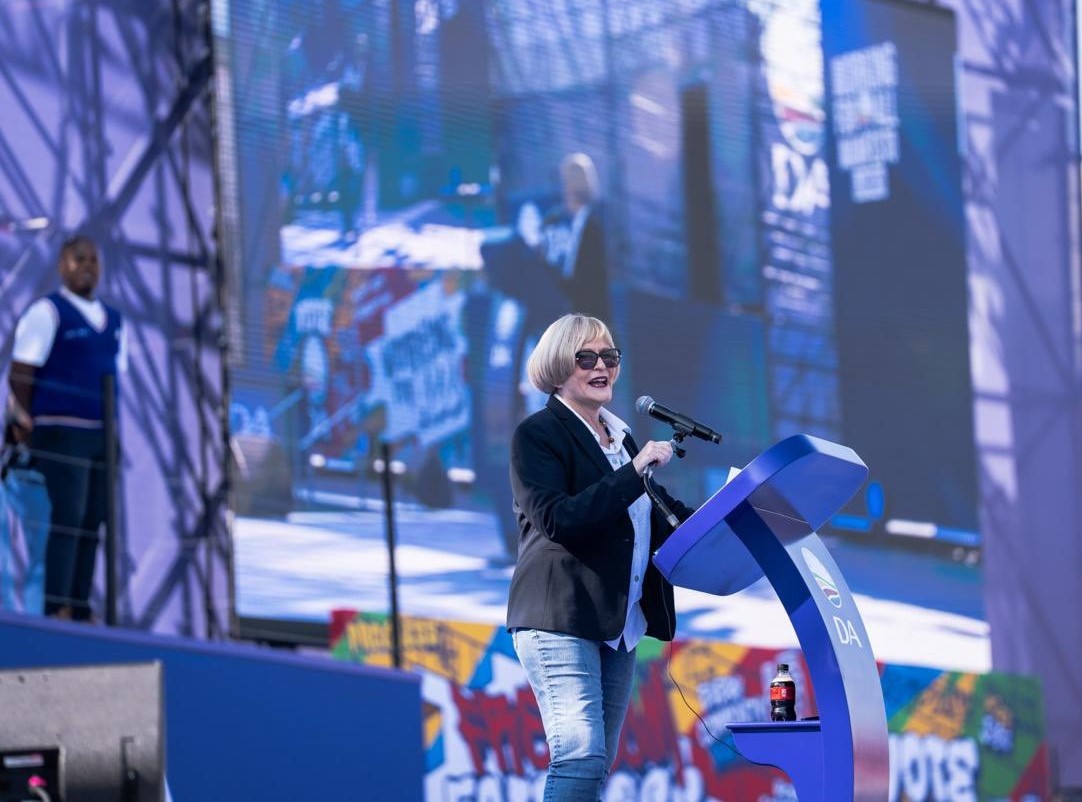 Helen Zille speaks at the DA's manifesto launch on Saturday. Photo: @HelenZille4Jozi on x.com
National unemployment highest in 4 years
Following the latest Quarterly Labour Force Survey released today, DA leader Geordin Hill-Lewis says it is clear that South Africa’s jobs crisis is worsening, not improving. "Economic reform is happening far too slowly to spur growth at the pace required to create jobs. South Africa does not lack economic potential. It lacks urgency," Hill-Lewis says.
The number of unemployed South Africans increased by 345 000 to 8,5 million in the second quarter of 2026, while employment declined by a further 16 000.
Official unemployment increased from 32,7% to 33,6%, while the broader measure of unemployment and the potential labour force rose to 43,8%.
This is the highest unemployment rate in four years.
Western Cape creates 91 000 jobs
In stark contrast to the national unemployment rate, unemployment in the Western Cape has shown a small decrease to 19,5% in Quarter 2 of 2026, down from 19,6% in the previous quarter.
The Western Cape’s unemployment rate has been below 20% for over a year, and over the past 10 years, the province’s unemployment rate has consistently remained below the national average.
Seven out of ten sectors in the province recorded year-on-year gains in employment, driven by the finance (+41 000), trade (+41 000) and agriculture (+26 000) sectors.
The provincial labour absorption rate, the share of the working age population that is employment, also grew 1,1% year-on-year reaching 55,7% compared to 39,6% nationally.
Western Cape Minister of Agriculture, Economic Development and Tourism, Dr Ivan Meyer, welcomed the latest figures. "While South Africa lost 68 000 jobs year-on-year, the Western Cape created 91 000 jobs over this period."
Western Cape Premier Alan Winde says every decrease in the unemployment rate is encouraging.
"The province and its residents have faced an incredibly difficult three months, marked by several weather events that wreaked havoc on infrastructure and the agricultural sector, in particular, which is a major economic driver in the province.
"We know we must and can do more to grow our economy. We will push even harder to bring more investment to our province that creates many more jobs,” Winde says
Hill-Lewis says nationally businesses and investors are still held back by red tape, unreliable basic services, failing ports and rail while crime makes it harder and more expensive to build, invest and employ people.
‘We bring you the latest Garden Route, Hessequa, Karoo news’